Mission selection
Starshot would assess scientific objectives and select a mission concept for further development.
 STARSHOT AEROSPACEContact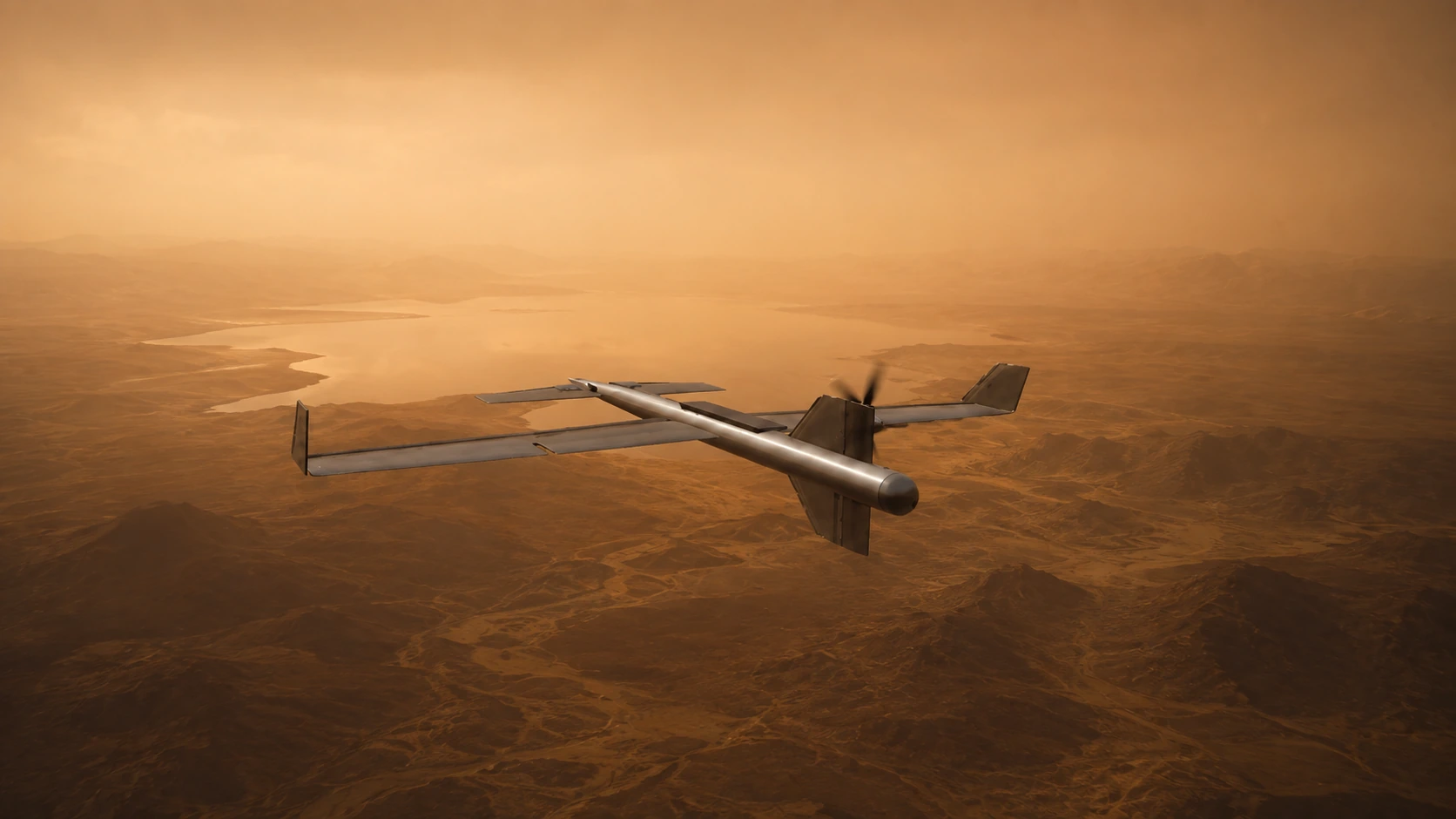
MISSION STUDY / TITAN ATMOSPHERIC SCIENCE
A concept for a radioisotope-powered aircraft that would study Titan through powered climbs, gliding flight and repeated observations.
STARSHOT SCIENTIFIC PARTNERSHIP PROGRAMME
Partner organisations could propose instruments for standardised payload bays. Common interfaces would aim to reduce the aircraft changes needed for each instrument.
MISSION IN ONE LINE
NAVIGATER would alternate gradual powered climbs with gliding observation periods. Repeated flights over selected regions could build a picture of Titan's atmosphere, surface, lakes and seas.
The study focuses on endurance and regional access. It examines whether the aircraft could revisit targets and release small probes while keeping the main vehicle airborne. Flight duration and payload capability remain to be established.
HOW PARTICIPATION WORKS
The proposed bays would use common mechanical, electrical and data interfaces. A shared power budget would limit high-power experiments to scheduled periods. Instruments exposed through the fuselage would need to operate at Titan's ambient pressure and temperature.
Starshot would assess scientific objectives and select a mission concept for further development.
A future mission announcement would include objectives, environmental conditions and the interfaces available to partner instruments.
The current concept allocates five of eight science bays to core instruments and three to partner organisations.
The three proposed partner bays would serve different organisation categories under published selection rules.
Starshot would coordinate instrument integration and qualification. Interface reviews would cover mechanical fit, electrical compatibility and software alongside environmental and planetary-protection requirements.
Starshot would operate the aircraft and coordinate navigation, communications and power. Partners would receive instrument data under the agreed service terms.
NAVIGATER BAY ALLOCATION
Five bays are proposed for core instruments and three for external partners. The partner categories below describe a possible allocation model rather than opportunities currently open for booking.
NAVIGATER COMMERCIAL MODEL
A partner agreement would define payload accommodation, integration and qualification. It would also specify mission support and data delivery. Starshot would retain responsibility for operating the aircraft.
A reservation could follow scientific selection and confirmation that an instrument meets the bay requirements.
Integration payments would be linked to agreed reviews, qualification work and installation milestones.
The operations agreement would define commanding, power scheduling and communications as well as the format of delivered data.
Further observations could be agreed if aircraft health and mission funding allowed an extension.
Financial viability would depend on the full mission cost and the funding committed. Assessment would include development, integration, launch and operations alongside insurance, contingency and financing. Reservations alone would not establish profitability.
CURRENT BASELINE
TITAN OPERATING ENVIRONMENT
Titan's dense atmosphere makes aerial exploration worth studying, but the cold environment creates demanding thermal and material requirements. NAVIGATER would use climb-and-glide cycles to seek longer regional observation periods. Its endurance remains a design objective.
MISSION ARCHITECTURE
The proposed flight cycle alternates powered climbs with gliding observations. Energy use and instrument activity would need to be scheduled around the aircraft's changing altitude and available power.
The propeller steadily restores altitude using power from the RTG-supported electrical system.
The aircraft trades altitude for range through Titan's dense atmosphere.
Scheduled science modules operate through shared power, data and thermal interfaces.
The cycle continues as NAVIGATER builds an atmospheric and surface picture over time.
PAYLOAD SYSTEM
A common interface specification would define bay dimensions, mounting points and electrical connections. Each instrument would still need a compatibility review covering power, thermal behaviour and its effect on the aircraft.
EXAMPLE DEPLOYABLE EXPERIMENT
Titan Ocean Explorer is a proposed small probe for local measurements in a sea or lake. The dimensions and operating window below are preliminary assumptions. Buoyancy, flooding rate and communications remain unresolved.
The proposed mass and volume require a buoyancy assessment before a surface residence time can be claimed. Inlet size alone does not determine descent time. Probe attitude, fluid flow and radio performance would need to be analysed together.
Preliminary concept / not yet a flight-qualified design
FURTHER ENGINEERING WORK
Refine lift, drag, propeller sizing, glide ratio and altitude strategy using Titan-atmosphere simulations.
Determine radioisotope power output, energy storage and heat transfer needs for each mission phase.
Freeze bay dimensions, connectors, SpaceWire implementation, operating modes and qualification requirements.
Validate link budgets, antenna placement, autonomous navigation and the relay strategy for deployed experiments.
Define contamination controls and the release rules for any probe entering Titan's liquid environment.
Convert the concept into testable requirements, fault responses and a credible operations plan.
PARTNERSHIP VISION
A future mission announcement would provide the payload specification and environmental requirements. Partner teams could use these documents to propose instruments for review before integration.
Back to Space Systems