Select a target chain
Choose a sequence of asteroids whose orbits and scientific objectives are compatible with the spacecraft capabilities.
 STARSHOT AEROSPACEContact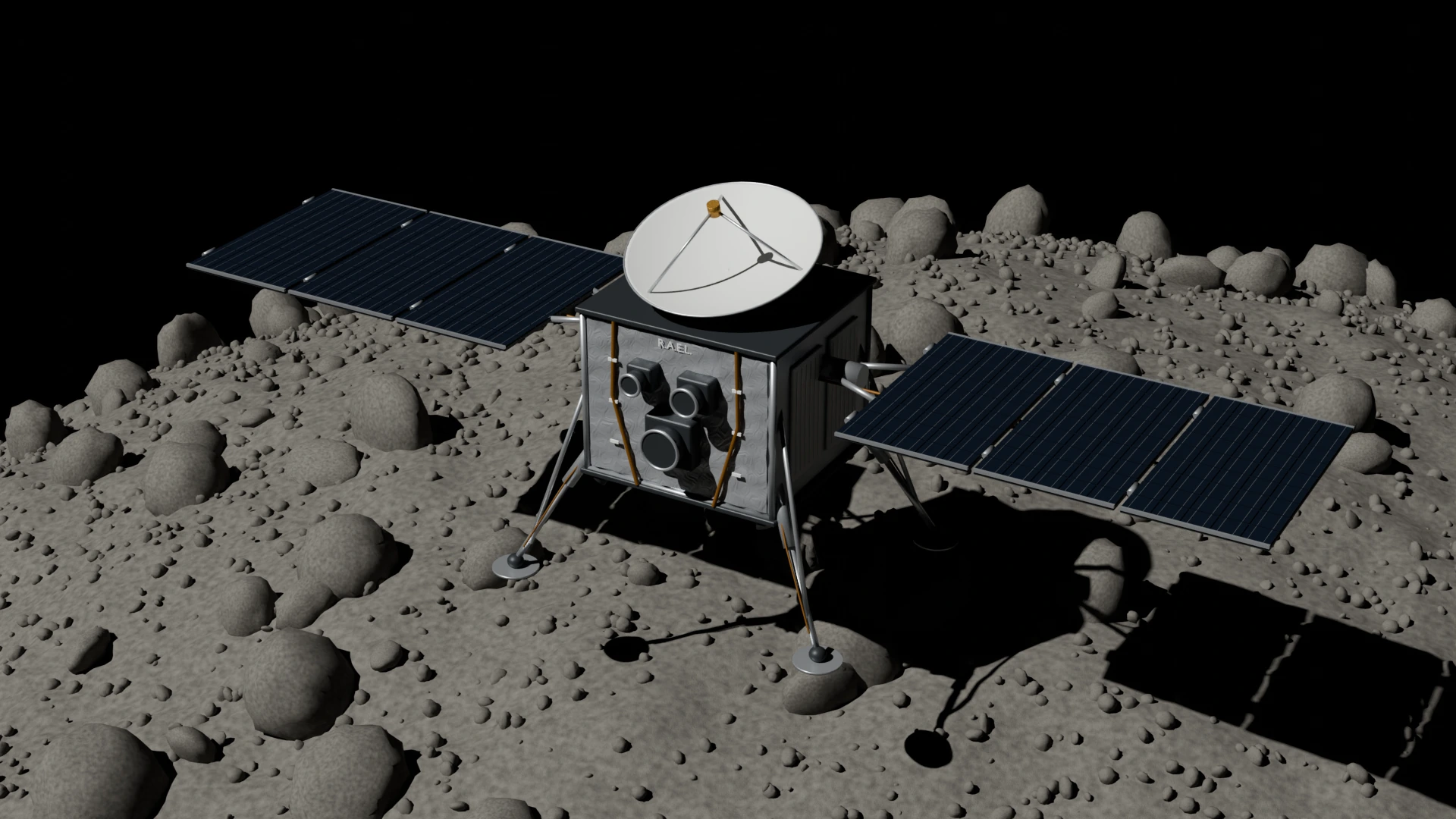
MAIN ASTEROID BELT / MULTI-TARGET EXPLORATION
A proposed solar-electric spacecraft series for asteroid rendezvous, close observation and selected surface-contact experiments.
Random Asteroid Explorer and Lander
R.A.E.L. is a proposed series of up to five missions over approximately 30 years. Later vehicles could reuse avionics and payload interfaces while extending their range or surface capability. Target selection would depend on orbital accessibility and scientific value. No flight schedule or payload booking is confirmed.
Preliminary programme architectureCURRENT STUDY
MISSION PROFILE
The sequence is a mission concept. Timings and performance targets require trajectory and system analysis.
Choose a sequence of asteroids whose orbits and scientific objectives are compatible with the spacecraft capabilities.
Solar arrays would power ion thrusters during long transfers. Available power and thrust duration would set the achievable route.
Imaging and navigation measurements would estimate the asteroid shape, rotation and local environment before close operations.
The spacecraft would use a bound orbit where practical or a controlled relative trajectory where the gravity field makes orbiting unsuitable.
Surface contact would be considered only after reconnaissance. Landing gear and any anchoring system would need to limit rebound in weak gravity.
After an observation campaign, the propulsion system would guide departure and begin the next planned transfer.
SPACECRAFT ARCHITECTURE
These systems describe the proposed design and the work needed to assess it.
Solar arrays would be sized for main-belt conditions. Batteries would support planned intervals when generation is insufficient.
Throttleable xenon ion thrusters are proposed for inter-asteroid transfers and rendezvous manoeuvres. Lifetime and propellant requirements remain to be established.
Camera and lidar measurements would support navigation around bodies with uncertain shape and gravity.
The proposed landing system combines a slow approach with compliant legs and possible anchoring. Surface interaction would require testing.
Candidate instruments would study surface composition and structure through imaging, spectroscopy and particle measurements.
Later missions could carry a separate lander, allowing the orbiter to continue observation and relay duties after deployment.
PROPOSED SCIENTIFIC PARTNERSHIP MODEL
A future agreement would define instrument accommodation and integration along with operations and data delivery. Starshot would operate the spacecraft. Development would depend on an agreed scope and sufficient committed funding.
Partner instruments could be selected against mission-specific limits for mass, power and viewing geometry.
A partner could propose a focused observation campaign at a target included in the approved mission route.
Surface experiments would require additional accommodation and qualification reflecting the risks of contact.
A shared design could support later missions if scientific demand and funding justified continued development.
Financial assessment would compare committed funding with the full cost of development and operations. It would also account for launch, integration and insurance alongside contingency and financing costs.
ENGINEERING PRECEDENT
NEXT STEPS
Mission-specific figures are preliminary targets or assumptions. They may change as the trajectory and system designs are developed. The references describe relevant science and prior missions; they do not validate this proposed spacecraft.
Back to Space Systems