Launch first
The proposed schedule launches the orbiter a year before NAVIGATER. Transfer times and commissioning would need to align so the relay is ready for aircraft operations.
 STARSHOT AEROSPACEContact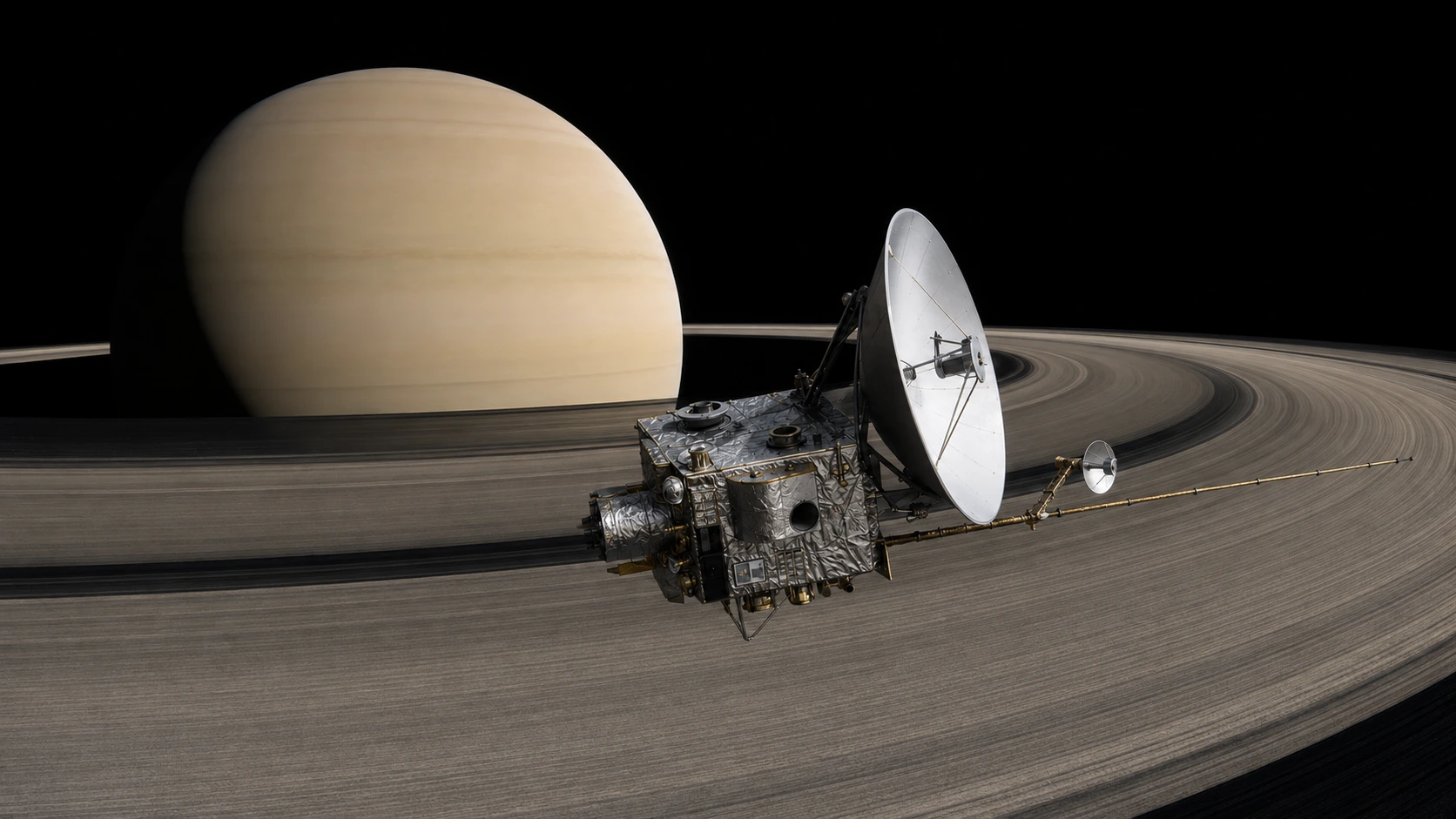
SATURN SYSTEM / RELAY AND SCIENCE ORBITER
A proposed Saturn orbiter that would relay data from NAVIGATER and conduct observations of Saturn and its moons.
Saturn Communications Orbiter and Titan Interceptor
The study assumes a launch one year before NAVIGATER and a cruise of approximately five years. A Titan flyby and a chemical capture manoeuvre would place the orbiter around Saturn. Later Titan encounters could reshape its orbit. The launch schedule and encounter altitudes remain targets for trajectory analysis.
Preliminary mission architectureCURRENT STUDY
MISSION PROFILE
The sequence is a mission concept. Timings and performance targets require trajectory and system analysis.
The proposed schedule launches the orbiter a year before NAVIGATER. Transfer times and commissioning would need to align so the relay is ready for aircraft operations.
A five-year transfer is the current target. Launch energy and planetary geometry would determine the available arrival paths.
The study considers a Titan flyby at approximately 800 km altitude alongside chemical propulsion for Saturn capture. Atmospheric effects and the encounter sequence need detailed assessment.
The candidate orbit would reach the vicinity of Titan at its most distant point. Any passage inside the main rings would require a validated route clear of hazardous material.
Repeated Titan flybys could alter orbital energy and inclination. Electric propulsion is considered for smaller corrections, subject to the available power.
A relay antenna would communicate with NAVIGATER. A separate Earth link would return the aircraft data and the orbiter science measurements.
SPACECRAFT ARCHITECTURE
These systems describe the proposed design and the work needed to assess it.
The concept uses separate antennas for Titan relay and Earth communications with onboard storage to accommodate gaps in contact.
Chemical propulsion would provide capture thrust. Electric propulsion is a candidate for later corrections, with attitude-control thrusters supporting pointing.
A radioisotope power system is proposed. Its output would need to cover instruments, communications and any electric propulsion within a validated energy budget.
Optical navigation and star trackers would support encounter targeting. Autonomous fault responses would need to protect the vehicle during long communication delays.
Candidate measurements include imaging, infrared spectra and radio science alongside observations of fields, particles and dust.
Orbit design must account for dust, ring-plane crossings and atmospheric clearance. The concept assumes no passage through visible ring material.
PROPOSED SCIENTIFIC PARTNERSHIP MODEL
A future agreement would define instrument accommodation and integration along with operations and data delivery. Starshot would operate the spacecraft. Development would depend on an agreed scope and sufficient committed funding.
Partner instruments could receive agreed allocations of mass, power and data within the Saturn science programme.
Relay agreements could define contact windows and data volumes for NAVIGATER or compatible future Titan vehicles.
Partners could propose moon or ring observation campaigns that fit the approved orbital tour.
Additional relay and science operations could be considered after the primary mission if funding and spacecraft health allowed.
Financial assessment would compare committed funding with the full cost of development and operations. It would also account for launch, integration and insurance alongside contingency and financing costs.
ENGINEERING PRECEDENT
NEXT STEPS
Mission-specific figures are preliminary targets or assumptions. They may change as the trajectory and system designs are developed. The references describe relevant science and prior missions; they do not validate this proposed spacecraft.
Back to Space Systems